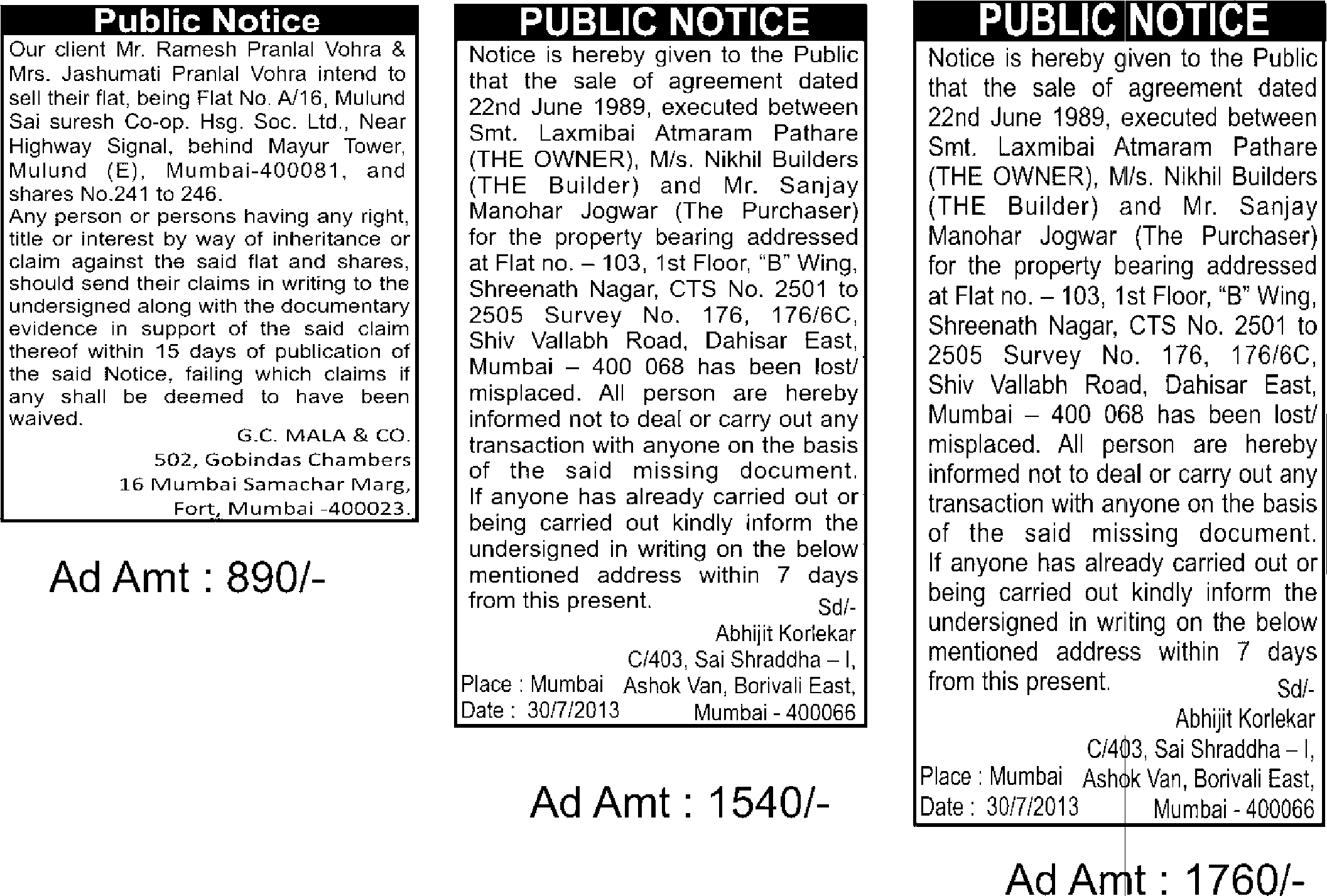
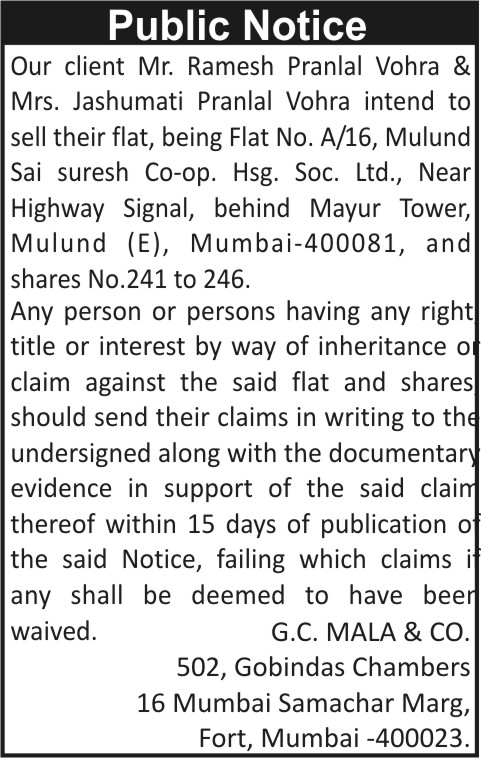
A public notice advertisement in a newspaper is a formal announcement made to inform the general public about a legal matter, transaction, or event. It is typically published to invite objections or claims from any person who may have an interest in the subject matter.
Such notices are commonly used in property transactions, loss of documents, and corporate actions. Once published, it creates constructive notice. This means the law presumes the information has been made available to the public.
Release PUBLIC NOTICE NEWSPAPER ads online in 2 Newspapers for less than 1000/- using our tips
There are times when one needs to publish PUBLIC NOTICE NEWSPAPER ads for cases like :
making a property deal
Father / mother dies without making any nomination
you may have a dispute in the family
You may have lost your essential documents while travelling
Public notice ads in newspaper for loss of sale agreement
Claim against legal heirs of the property
loss of society share certificate
Public Notice ads in Newspaper for Property on Auction
Public Notice ads in Newspaper investigating the title of the property
CANCELLATION AND TERMINATION OF AGREEMENT
PUBLIC Notice ads in Newspapers for Dissolving of Oral agreement between Purchaser and Seller
etc, etc.
PUBLIC NOTICE AD FORM
Just Fill the Form below with your Draft / Ad matter. Get Readymade ad Matter with quote FREE in 30 Min to 2 Hrs. Timings 10 am to 7 pm. Sundays Holiday. or Simply email us on publicnoticeads@gmail.com
✅Who can give a Public Notice?
Public notices are issued by government entities such as local and state, and also by Individuals. They can also be given by courts, municipalities, regulatory bodies, and other authoritative organizations.
The purpose is to inform the public about legal proceedings, policy changes, public meetings, or other matters of public interest.
The duration of a public notice can vary depending on the legal or regulatory requirements governing the notice. Typically, the duration is specified by law and can range from a few days to several weeks.
For example, public notices about upcoming public meetings might be posted for at least 10 to 14 days prior to the meeting, while notices published by individuals like loss of share certificates / claim – objection property notices or court notices need to be placed only once.
⚖️ Structure of a Legally Valid Public Notice Essential Clauses
A properly drafted public notice must include the following elements to be legally enforceable
Clause
Purpose
Risk if Missing
📰 Title (“Public Notice”)
Identifies legal nature
May be ignored
📌 Subject Description
Identifies property/document
Ambiguity
⚙️ Claim Clause
Covers all legal rights
Limited protection
⚠️ Objection Clause
Invites claims
Weak notice
⏱️ Time Limit
Defines response period
Open-ended
🔒 Consequence Clause
Enables action
No closure
LEGALLY ESSENTIAL PHRASE “any claim, right, title or interest”
✅ The inclusion of phrases such as “any claim, right, title or interest” ensures that all categories of legal claims are covered — preventing loopholes and future disputes.
📋
🔍 Drafting Takeaway:
A public notice missing any of these six clauses risks being challenged, ignored, or declared invalid. The Claim Clause + Objection Clause + Time Limit create the legal “shield” for decisive action.
⚖️ Informational reference — based on standard Indian & common law notice practices. Consult a legal professional for jurisdiction-specific wording.
✅Guidelines on How to Publish Public Notice in Newspaper :
Publishing a public notice in a newspaper involves few steps. Here’s a general guide to help you through the process:
➤1. Determine Requirements:
Legal Requirements: Understand and study the requirements of public notices, Is it a simple loss of loss of property documents or an advocate notice? Or is it a Loss of Share certificate. This can vary depending on the type of notice and jurisdiction.
Newspaper Guidelines : Review the guidelines of newspapers regarding public notices. Some notices require ads on advocate letterheads, Some require court notices whereas some require society letters.
➤2. Prepare the Notice:
Content: Write a clear and concise notice that includes all required information. This often includes dates, details of the event or action, Property document details, Lost share details like Folio nos, Distinctive share nos, certificate nos, contact information, and any legal language required by the governing regulations.
Format: Follow any formatting guidelines specified by the newspaper or legal regulations. This may include specific headers, font sizes, or other stylistic requirements.
➤3. Choose a Newspaper:
Local Reach: Select a newspaper with wide circulation in the area affected by the notice like The Times of India, Dainik Jagran or Indain Express. For certain types of notices, you might need to choose a publication with a specific level of circulation or distribution.
Reputation: Choose a reputable newspaper that meets the legal requirements for publishing public notices in your area.
➤4. Submit the Notice:
Contact the Newspaper / Agency: Reach out to the newspaper’s / agency’s classified or legal advertising department. You can usually do this via phone, email, or through their website.
Provide Details: Submit your prepared notice and any necessary documentation. You may need to provide proof of legal compliance or other supporting materials.
Review and Confirmation: Review the draft provided by the newspaper / agency for accuracy. Confirm the publication dates and any costs associated with the notice.
➤5. Payment:
Fees: Pay any applicable fees for publishing the Public notice. Fees can vary based on the newspaper’s rates, location, the size of the notice, and the number of publications.
➤6. Publication:
Proof of Publication: After the notice is published, obtain a proof of publication from the newspaper. This is often required for legal compliance and may need to be submitted to a court or Municipality or Society Office.
➤7. Follow Up:
Monitor: Keep track of the notice to ensure it appears as scheduled and is correct. If any issues arise, contact the newspaper promptly to address them. By following these steps, you can ensure that your public notice is properly published and complies with all relevant requirements.
📰 Types of Public Notice Ads With Practical Use
Legal advertising guide — published notices for claims, rights, and compliance
Type of Public Notice
Practical Use / Trigger Event
Key Protection / Purpose
🏡 1. Property Public Notices
Issued before purchasing property to identify any undisclosed claims, rights, or encumbrances.
Uncovers hidden mortgages, liens, inheritance claims → clean title assurance.
📜 2. Share Certificate Loss Notices
Published when share certificates are lost before issuing duplicates to the rightful owner.
Prevents fraudulent transfer or duplicate claim; creates legal evidence of loss.
🏢 3. Society Share Certificate Notices
Used in cooperative housing societies to avoid disputes over membership, shares, or ownership rights.
Avoids membership conflicts, establishes clear chain of title in society records.
✍️ 4. Name Change Notices
Required as part of legal identity change procedures (after marriage, deed poll, or court order).
Public declaration of new identity; prevents future disputes on credentials & records.
🏛️ 5. Corporate Notices
Statutory & regulatory advertisements for company events / restructuring
Legal compliance + stakeholder protection
📌 INC-26
Company conversion (e.g., private to public, or conversion of LLP to company)
Section 8 company (non-profit / license for charitable objects)
Public notice for name approval & incorporation with charitable status.
📌 URC-2
Entity to company conversion (proprietorship / partnership to private limited)
Gives existing creditors and public chance to raise objections, ensures smooth transition.
📌
🔍 When to choose which public notice?
Property due diligence → Property Public Notice • Lost financial instruments → Share/Society Certificate Notice • Personal legal change → Name Change Notice • Corporate restructuring → INC‑26 / INC‑25 / URC‑2. 🧾 All notices must contain a clear objection clause, time limit (7 to 15 days typical), and consequence clause for legal finality.
⚖️ UNIVERSAL COVERAGE PHRASE “any claim, right, title or interest”
✔️ Recommended for every public notice type to prevent legal loopholes
⚡ Informational guide based on standard Indian & common law practices. For specific legal matters, consult a qualified attorney. Public notice requirements vary by jurisdiction.
What is the duration of a public notice?
The Duration of a public notice depends on its purpose and legal requirements:
General Notices: Usually 7–15 days, such as for lost documents or announcements.
Property Notices: Typically 15–30 days to allow objections or claims related to property transactions or disputes.
Legal Notices: Governed by law, like 15 days for month-to-month lease terminations or 6 months for year-to-year leases under Section 106 of the Transfer of Property Act.
Newspaper Notices: The notice is valid for the period mentioned in it, though it can remain relevant as legal evidence later.
These durations ensure fairness and give sufficient time for the public to respond.
⚖️ What is Constructive Notice? Legal Understanding
The legal presumption that the public is informed once a notice is published in a recognized medium — whether read or not.
📢
Constructive notice: a deeper legal definition
Constructive notice means that once a matter is published in a recognized public medium — such as a newspaper, official gazette, or government portal — the law conclusively presumes that the public has been informed, regardless of whether a specific person actually read the notice.
🧾 Core idea: “Ignorance of a properly published notice is no excuse in the eyes of the law.” This legal fiction protects good-faith actions and forces diligence.
⚖️ Widely relied upon in legal proceedings to establish:
📰1. Adequate disclosure
The notice meets the legal standard of informing all interested parties through widely accessible channels — no secret or hidden notification.
⏳2. Opportunity to object
Once published, affected parties are given a fair window (often 15 days) to raise claims, rights or objections — after which the opportunity lapses.
🛡️3. Good faith action
The person issuing the notice demonstrates due diligence and transparency — strengthening legal protection against future disputes or allegations of fraud.
📋 Legal comparison: constructive vs. actual notice
Aspect
Constructive Notice
Actual Notice
Basis
Legal presumption from publication
Direct communication (verbal/written)
Proof required
Affidavit of publication & newspaper cutting
Signed acknowledgment / delivery evidence
Defense of ignorance
❌ Not accepted (law imputes knowledge)
⚠️ Not possible if actual notice proved
🏛️ How constructive notice works in real life
Example: A person issues a public notice in a widely circulated newspaper regarding the loss of a share certificate and invites claims within 15 days. Even if a previous owner never reads that newspaper, the law treats them as informed after publication. If they fail to object within the stipulated period, their claims may be permanently barred. Courts routinely rely on constructive notice to uphold transfers of property, shares, and company conversions.
💡 Legal takeaway: Constructive notice transforms a newspaper ad into a binding legal instrument — eliminating “I didn’t know” as a valid excuse.
📖 Doctrine of Public Notification
“A person is presumed to know what the public knows.” The principle ensures that legal proceedings are not stalled by willful or accidental ignorance. It supports finality in transactions and reduces endless litigation.
📌Essential elements for valid constructive notice
Publication in recognized newspaper (wide circulation)
Clear description of subject matter (property/asset/right)
Invitation to raise objections (with deadline)
Consequence clause (non-response = waiver of claims)
“Constructive notice is the legal bridge between publication and legal duty — once a notice is properly published, the law imputes knowledge to all, ensuring fairness, transparency, and finality.”
✔️ Recognized under the Indian Evidence Act, Transfer of Property Act, and company law frameworks.
⚖️ Enhanced definition for legal professionals & public understanding — based on common law and statutory principles. Always consult a lawyer for jurisdiction-specific effect.
📰 Why Publish Public Notice Ads in Newspapers? Legal Imperative
Newspaper publication = legal proof of constructive notice | Trusted by courts, RoC, and financial institutions
📢 Need newspaper publication support? 📱 8888337371 📞 9090353586 PAN India | Affidavit + Newspaper cutting
Newspapers remain the gold standard for public notice advertisements because they combine wide circulation, legal presumption of knowledge, and statutory recognition. Unlike social media or websites, a newspaper notice creates irrefutable evidence of constructive notice — a legal fact that courts, registrars, and financial institutions have relied upon for over a century.
Reason / Benefit
Why Newspapers? (Legal & Practical)
⚖️ Constructive Notice (Legal Presumption)
Under the Indian Evidence Act, 1872 (Section 114), courts presume that a newspaper notice was seen by all interested parties. This shifts the burden of proof — the non-claimant cannot later say “I didn’t know.”
🏛️ Statutory & Regulatory Mandate
Companies Act, 2013 (INC‑26, URC‑2, INC‑25), SARFAESI Act, CPC (Order V Rule 20), and SEBI regulations explicitly require newspaper publication — not websites or social media.
📜 Admissible Court Evidence
A newspaper cutting + affidavit of publication is directly admissible as evidence in civil, criminal, company law, and consumer disputes. No further proof of service is needed.
🌍 Wide & Verifiable Circulation
Newspapers have audited circulations, date-stamped editions, and permanent archives. This creates a time-stamped, tamper-proof record — unlike websites that can be altered or taken down.
⏳ Time-Bound Finality
Newspaper notices trigger statutory time limits (usually 30 days). After expiry, claims are legally barred — providing closure for property purchases, share certificates, and company conversions.
🛡️ Good Faith & Due Diligence
Courts and RoC treat newspaper publication as proof of bonafide effort. Even if no objections arise, the notice protects the issuer against future fraud allegations.
📊 Newspaper vs. Website/Social Media – Legal Weight
📰Newspaper Notice
✔ Legally presumed knowledge
✔ Admissible without witness
✔ Statutorily mandated
✔ Time-stamped & archived
✔ Accepted by RoC / Courts / Tribunals
💻Website / Social Media
❌ No presumption of notice
❌ Proof of publication difficult
❌ Not accepted for statutory notices
❌ Can be altered / deleted
❌ Rejected by RoC and most courts
📌Practical requirement: English + Vernacular newspaper
For most statutory notices (Companies Act, property, share loss), you need one English newspaper (wide circulation) and one regional language newspaper (Hindi, Marathi, Gujarati, Tamil, Telugu, etc.) — ensuring reach to local stakeholders.
“A public notice in a newspaper is not a mere formality — it is the most reliable legal instrument to establish constructive notice, trigger statutory time limits, and protect against future claims. Courts have repeatedly held that publication in a widely circulated newspaper satisfies the requirement of due diligence.”
📢
Publish your public notice across India
English + Regional newspapers | Courier of original Newspaper cuttings
⚖️ Based on Indian Evidence Act, Companies Act, CPC, and judicial precedents. WP Bakery ready | No external images | Fully responsive
🏛️ Legal Basis and Recognition in India Statutory & Judicial Backing
While public notice advertisements are not governed by a single statute, their use is recognized and supported across multiple legal frameworks in India.
⚖️Multi‑statute recognition: no single law, but pervasive legal acceptance
Indian courts, tribunals, and regulatory authorities consistently rely on public notices as a mechanism for transparency, constructive notice, and due process — even without a consolidated “Public Notice Act”.
Legal Framework / Statute
Relevant Provision / Mechanism
Practical Role of Public Notice
📜 Transfer of Property Act, 1882
Doctrine of due diligence & protection of bonafide purchasers (Sections 40, 53, 55)
Public notices help identify undisclosed claims, encumbrances or equitable rights not reflected in revenue or sub-registrar records. Serves as evidence of constructive notice before purchase.
⚙️ Civil Procedure Code, 1908 (CPC)
Order V, Rule 20 – Substituted service by newspaper publication when defendant cannot be located.
Courts permit service of summons, notices or injunction orders through widely circulated newspaper — legally deemed sufficient service, ensuring right to be heard even when whereabouts unknown.
🏢 Companies Act, 2013
Section 13 (alteration of MOA/AOA), Section 14 (conversion), Rules for INC‑26, URC‑2, INC‑25 (Section 8 companies)
Public notice mandatory for company conversion, change of name, conversion of partnership/OPC to private company. Protects stakeholders, creditors, and invites objections before ROC approval.
📊 Financial & Securities Matters
SEBI (LODR) Regulations, Companies (Issue of Share Certificates) Rules, 2020
Before issuing duplicate share/debenture certificates, companies must publish notice in a newspaper → prevent fraud, competing claims, and unlawful transfer. Constructive notice binds all potential claimants.
⚡
Judicial endorsement & evidentiary value
Indian courts (including Supreme Court & various High Courts) have consistently held that a public notice published in a newspaper constitutes valid constructive notice under the Evidence Act, 1872 (Section 114 – presumption of due course of business). It acts as proof of due diligence and shifts the burden of proof onto the party who failed to respond.
✅ Key recognition: RICB (Registrar of Companies), Civil Courts, Debts Recovery Tribunals (DRT) and Consumer Forums accept public notice affidavits as evidence of compliance with natural justice.
📰 Transfer of Property Act, 1882
Public notice = prudent purchaser’s shield against hidden claims. Supports the rule that “inquiry from all available sources” includes newspaper notice when title defects are suspected.
🏛️CPC Order V Rule 20
Substituted service by newspaper publication has the same legal effect as personal service. Courts frequently allow this when defendant is avoiding service or untraceable.
📌Companies Act, 2013 (Rules)
INC‑26 (company conversion), URC‑2 (entity conversion), INC‑25 (Section 8 license) — all require advertisement in at least one English and one vernacular newspaper.
“While no single ‘Public Notice Act’ exists in India, the mosaic of statutes — Transfer of Property Act, CPC, Companies Act, and SEBI regulations — creates a robust legal foundation. Public notices are not mere formalities; they are instruments of constructive notice and due process, repeatedly upheld by Indian courts.”
⚖️ Informational legal resource — for professional use. Based on statutory provisions and judicial precedents as of 2025. Consult a qualified lawyer for case-specific applicability.
📰 How to Give a Public Notice in a Newspaper Complete Guide
Step-by-step process from drafting to publication — legally compliant & court-accepted
✅ 7-Step Process to Publish a Public Notice
1
Draft the Notice Content
Include: title “Public Notice”, subject description, claim clause (“any claim, right, title or interest”), objection clause, time limit (usually 30 days), consequence clause, and your signature/contact details.
2
Prepare Affidavit (Notarized)
An affidavit stating the facts (loss of document, property purchase, name change) must be notarized. This is submitted to the newspaper as proof of bona fide intent.
3
Select Newspapers (English + Vernacular)
Choose a widely circulated English newspaper (e.g., Times of India, The Hindu, Hindustan Times) and a regional language newspaper (e.g., Dainik Bhaskar, Maharashtra Times, Amar Ujala, Dinamalar) based on location.
4
Submit to Newspaper’s Classified/Public Notice Department
Provide the draft + affidavit. The newspaper will advise on word count, cost, and required format. Payment is made via NEFT, cheque, or online.
5
Get Proof / Approval (Pre-publication)
The newspaper sends a proof (draft of how it will appear). Review carefully for errors in dates, names, or legal wording.
6
Publication on Scheduled Date
The notice appears in the newspaper. Keep multiple original copies (physical newspaper) — these are critical legal evidence.
7
Collect Affidavit of Publication
The newspaper issues an affidavit/certificate confirming the date and edition. This + original newspaper cutting = court-admissible evidence.
📋 Documents Required for Newspaper Public Notice
Document
Purpose / Remarks
📄 Draft of Public Notice
Clear, legally worded (as per situation)
⚖️ Notarized Affidavit
Sworn statement of facts (loss, due diligence, etc.)
🆔 Identity Proof (Aadhaar/PAN/Passport)
For verification by newspaper
🏠 Address Proof
Residence/business address
📎 Supporting Documents (if any)
FIR for lost certificate, court order, etc.
💰Estimated Cost
₹890 – ₹5000+ depending on newspaper, word count, city, and language. English dailies cost more than regional. Additional charges for affidavit and courier.
⏱️Typical Timeline
1-2 working days from submission to publication. Urgent publication (next day) possible with additional fees.
🔔 After publication: Maintain the original newspaper cutting + affidavit of publication. This is your only legal proof of constructive notice. For statutory filings (RoC, court, society), you may need attested copies.
📢
Need help drafting or publishing?
We handle end-to-end: draft, affidavit, newspaper coordination, original cuttings
⚖️ Based on standard newspaper publishing practices & legal requirements in India. WP Bakery ready | Fully responsive
➤Common questions related to your Public notice in Newspaper ?
Q. Do you have Legal Notice Format for placing Notice ads? A. We have a list of 30 – 35 Legal notice Formats (database) available with us for FREE download. These are the request matters which we regurarly receive on a day to day basis. You may download them for FREE. Share them with your friends, Edit them as per your convenience and send it back to us on publicnoticeads@gmail.com. Our team shall get back to you in 15 to 60 min with the ad matter and quotation.
Q. Are there any supporting documents required for placing a Public Notice in newspaper? A. Usually Notice ads can be placed easily without any hazzles in major newspapers across India. However some publication houses insist that the public notice ad be accompanied with an Advocate letter or a Police complaint or an Affidavit or atleast with an adhar card. The requirement differs from case to case. However as stated earlier the requirement is applicable only in few newspapers where its absolutely compulsory.
Q. How will I know that my Public Notice is published in newspaper ? A. We inform you a day in advance about the date on which Public Notice ad is likely to be Published in the Newspaper, so that you have sufficient time to buy the newspaper copies. Also you may always request for a soft copy on publicnoticeads@gmail.com to be sure that the ad has been published. Also if the ad is booked for Mumbai. Customers get free 2+2 newspaper copies through courier.
Q. Please provide me with the rates and payment options for placing a public Notice advertisement? A. Public notice advertisement rates differ from city to city across India. However In Mumbai the rates start from 890/- onwards for a Basic notice ad. In order to get the exact rates for Mumbai or any other city across India you may call on 8888 33 7371 / 9090 3535 86 / or on 98215 66 223. If you have the Notice ad ready with you, you may send us an email on publicnoticeads@gmail.com. We usually respond back in 15 min to 60 min during office hours (10.30 to 6.30 pm).
Q. Can you help me in composing my Public Notice ad ? or Can you give me the Legal Notice format ? A. Usually the legal Notice format is to be provided from your end or from your advocate. In case you do not have the legal notice format than you may kindly download from our database for FREE.
Q. Do you Publish Public Notice ads in Delhi Newspapers ? A. Yes we Publish Public Notice ads in Delhi Newspapers and also in surrounding areas like Gurgaon, Gaziabad, Noida, Faridabad and in the neighbouring states of Haryana and Uttar Pradesh. for more details click here
Q. Do you Publish Public Notice ads in West Bengal Newspapers ? A. Yes we Publish Public Notice ads in newspapers in west bengal in cities like Kolkata, Darjeeling, Howrah, Siliguri, North 24 Parganas. For more details click here.
Q. In Which cities do you publish Public Notice ads in India ? A. We Publish Newspaper Notice ads all across India, However we specialize ourselves in States like Maharashtra, Delhi, Haryana, Uttar Pradesh, West Bengal, Gujarat, Karnataka, Tamil Nadu, Andhra Pradesh, and Kerala
Q: What is the purpose of a public notice? A: The purpose of a public notice is to inform the public about governmental, legal, society, or civic matters.
Q: Where are public notices typically published? A: Public notices are usually published in newspapers which are registered with the government having decent circulation and readership
Q: What types of information are included in public notices? A: Public notices may include information about government contracts, advocate notices, equity and society shares lost, court summons, Auctions, Financial results and loss of documents.
Q: Why are public notices important? A: Public notices ensure legal compliance, transparency and public awareness by keeping citizens informed of major changes and decisions. They protect rights, minimize disputes and foster civic engagement by giving a platform for feedback. Ultimately they help in maintaining trust and accountability in society.
❓ Common Questions About Public Notice in Newspaper FAQ
Quick, authoritative answers to the most frequently asked questions — from legal requirements to practical execution
1What is a public notice in a newspaper?
A public notice in a newspaper is a formal legal announcement published in a widely circulated newspaper to inform the general public about a specific matter — such as property purchase, lost documents, name change, or company conversion. Under the Indian Evidence Act, 1872, such publication creates constructive notice, meaning the law presumes that all interested parties have been informed, regardless of whether they actually read it.
2When is a public notice required in a newspaper?
A public notice is required in the following situations:
Property Purchase — to identify hidden claims or encumbrances (Strongly Recommended)
Lost Share Certificate — before issuing duplicate (Practically Mandatory)
Society Share Certificate Lost — to avoid membership disputes (Required by practice)
Name Change — as part of legal identity change (Required with Gazette)
Company Conversion (INC-26) — mandatory under Companies Act, 2013
Document Loss — to prevent misuse (Recommended)
3Who can issue a public notice in a newspaper?
Any person or entity with a direct legal interest in the subject matter can issue a public notice. This includes:
Individuals — property buyers, lost certificate owners, name change applicants, legal heirs
Companies / LLPs — through authorized signatory (Director/CS)
Cooperative Societies — through Secretary or Managing Committee
Courts & Tribunals — for substituted service under CPC Order V Rule 20
Banks & Financial Institutions — for lost deposit receipts or SARFAESI notices
Government Authorities — ROC, RERA, Income Tax, Municipality
⚠️ Minors, persons of unsound mind, and unregistered entities cannot issue a valid public notice.
4How much does it cost to publish a public notice in a newspaper?
The cost varies based on several factors:
Newspaper choice — English dailies (Times of India, The Hindu) cost more than regional newspapers
Word count — typically ₹10–₹50 per word
City edition — metro editions cost more than smaller cities
Language — English & vernacular both required for statutory notices
💰 Estimated range: ₹890 – ₹15,000+ per notice (for two newspapers: English + Regional). Additional charges for affidavit and courier of original cuttings.
5 How long does it take to publish a public notice?
Standard timeline: 1-2 working days from submission to publication.
Urgent publication: Next-day publication possible with additional fees (express charges).
📌 FREE: All ads are composed Free from our end
6 Which newspapers are approved for public notice publication?
For legal validity, choose newspapers with wide circulation and statutory recognition:
📰 English Newspapers
The Times of India
The Hindu
Hindustan Times
The Indian Express
The Telegraph
Deccan Chronicle
🗣️ Regional Newspapers
Dainik Bhaskar (Hindi)
Amar Ujala (Hindi)
Maharashtra Times (Marathi)
Dinamalar (Tamil)
Eenadu (Telugu)
Divya Bhaskar (Gujarati)
⚠️ For statutory notices (Companies Act), you need one English + one vernacular newspaper.
7 What is the legal value of a newspaper public notice?
A newspaper public notice has significant legal evidentiary value:
Creates constructive notice — law presumes public was informed
Admissible as evidence under Indian Evidence Act, 1872 (Section 114)
Serves as proof of due diligence in legal proceedings
Shifts burden of proof to non-respondents
Accepted by Courts, ROC, NCLT, DRT, Consumer Forums, and Tribunals
🔔 Important: You must preserve the original newspaper cutting + affidavit of publication as legal proof.
8Can a public notice be published online instead of newspaper?
No, for most statutory and legal purposes. While websites and social media can supplement awareness, they do not create constructive notice under Indian law.
Courts, RoC, and tribunals explicitly require newspaper publication for:
Substituted service under CPC Order V Rule 20
Company conversion notices (INC-26, URC-2, INC-25)
Lost share certificate notices
Property due diligence notices
❌ Online-only publication has no legal presumptive value and will be rejected by authorities.
9What documents are needed to publish a public notice?
📄 Draft of Public Notice — clearly worded with all clauses
⚖️ Notarized Affidavit — stating the facts and legal interest
⚖️ Based on Indian Evidence Act, Companies Act, CPC, Transfer of Property Act, and judicial precedents.
➤Procedure For Booking Public Notice Newspaper ads in India :
Lets say you have a Public Notice ad to be released in newspaper.
Step 1 : Call us on 9821566223 / 8888337371 for Guidance/Help for how to go about it. We’ll guide you with How to Publish your Publish Notice ad. OR Step 2 : You may already have the draft of the ad ready with you given by your Society / Lawyer
OR
You may have copied it from one of the newspaper clips. Just fill in Form provided.
If your Form reaches us during office hours between 10.30 to 8 pm you shall immediately be given quotation along with FREE ARTWORK within 30 minutes to 2 hrs time. We give options of few combination Newspapers of 1 English and 1 Local Newspapers. Once you approve of the Ad matter and Budget. You’ll have to transfer the payment. Ad shall appear next day or the day of your choice.
PUBLIC NOTICE NEWSPAPER ads being a formality are supposed to be placed in 2 newspapers. One English and One Local language. It is also understood that usually one does not want to have any response from such ad as such he/she is looking to fulfill his formality at reasonable / cheaper costs but at the same time the newspapers have to be registered and acceptable at all goverment organisations and courts as such he /she may be required to present the documents in courts and variety of places from time to time.
We at https://www.publicnoticeads.in take care in searching the right choice of papers for you which are cheap, registered and acceptable everywhere, our range is extremely cheap and basic ad starts from 890/- only in 2 newspapers.
Kindly note that 890/- is the basic cost of the ad in 2 newspapers and in no way does it indicate that all public notice ads shall cost 890/-. For further clarification on the rates you may call us on 9821566223 / 8888337371 for more details. Or You may just fill in the form on the left of the page and we’ll compose the ad FREE for you and give you the quote.
Alternatively if you do not have the Public notice ad / draft matter, you may check our free database and use one of FREE downloadable ads, compose the ad and send it to us on publicnoticeads@gmail.com to get FREE quote
Booking a public notice advertisement seems straightforward — but even experienced professionals make mistakes that can invalidate the entire legal purpose. Below are the most common errors, ranked by frequency and impact, with practical solutions to avoid them.
❌ Common Error
Consequence / Risk
✅ How to Avoid
Missing “Public Notice” title Using vague headings like “Important Information” or “Announcement”
Notice may be ignored or challenged — lacks legal identity. Courts may not recognize it as a valid public notice.
Always begin with “PUBLIC NOTICE” in bold, capital letters at the top of the advertisement.
No objection clause or time limit Failing to invite claims or specify a deadline
Notice becomes open-ended — no finality. Claimants can come forward years later, defeating the purpose.
Include: “Any person having any claim, right, title, or interest should file objections within 15 days…”
Incomplete legal phrase Omitting “any claim, right, title or interest” — using shorter, weaker wording
Limited legal protection — claimants may argue their specific type of right was not covered.
Use the full phrase: “any claim, right, title, interest, lien, or encumbrance of any nature whatsoever.”
Wrong newspaper selection Choosing a low-circulation or unrecognized newspaper to save cost
Notice may be rejected by courts/ROC as insufficient constructive notice. Legal presumption fails.
Select widely circulated, recognized newspapers (Times of India, The Hindu, Dainik Bhaskar, etc.) with audited circulation.
No vernacular newspaper (when required) Publishing only in English for local/regional matters
Statutory notices under Companies Act, SARFAESI become invalid. Local claimants can claim ignorance.
For most statutory notices, publish in one English + one regional language newspaper of the relevant area.
Incorrect or missing affidavit Submitting without a notarized affidavit or with an outdated one
Newspaper may refuse publication. Even if published, courts may reject the notice as unsupported.
Prepare a properly notarized affidavit with correct facts, date, and your signature. Keep a copy for records.
Notice becomes unenforceable — claimants can argue the description didn’t identify their interest.
Be specific: survey number, property ID, certificate number, society name, share certificate number, etc.
No consequence clause Failing to state what happens if no objection is received
No closure — even after 30 days, claimants may argue they didn’t know the consequence of silence.
Include: “If no objection is received within 30 days, it will be presumed that no claims exist and we shall proceed accordingly.”
Issuing without legal standing Person/entity publishing without direct legal interest
Notice is legally void ab initio. Courts and authorities will ignore it entirely.
Ensure you have documented legal standing — ownership, authorization, board resolution, court order, etc.
Not preserving original newspaper cutting Relying only on digital copy or forgetting to collect the physical newspaper
No legal proof of publication. Courts require original newspaper cutting as evidence — digital copies are not accepted.
Collect multiple original copies of the newspaper on the date of publication. Store safely. Obtain affidavit of publication from the newspaper.
Typographical errors in key details Wrong name, misspelled address, incorrect certificate number, wrong date
Notice becomes ineffective — the intended subject is not correctly identified. May require re-publication.
Proofread carefully before submission. Get a second person to verify. Request a proof from the newspaper before final printing.
Publishing on a holiday or non-publication day Notice appears in an edition with limited circulation
Constructive notice may be weakened — courts may question whether the notice reached the intended audience.
Publish on a regular weekday (Monday–Friday). Avoid Sundays, national holidays, and festival days.
✅
Pre-Publication Checklist — Verify Before You Book
☐Title clearly says “PUBLIC NOTICE”
☐ Subject description is complete and accurate (no typos)
☐ Claim clause includes “any claim, right, title or interest”
☐ Objection clause invites claims within a time limit (30 days)
☐ Consequence clause states what happens after the deadline
☐ Correct newspapers selected (English + vernacular if required)
☐ Notarized affidavit is ready and accurate
☐ You have documented legal standing to issue the notice
☐ Publication date is a regular weekday (not a holiday)
☐ You have arranged to collect original newspaper cuttings
🔔 Critical reminder: A single error in your public notice can render it legally invalid — wasting time, money, and leaving you exposed to future claims. Always verify before publication, or better, have an expert review your draft.
📢
Don’t let errors invalidate your public notice
Expert Public notice ads booking and publication coordination — PAN India